
People around the world have treasured pearls for thousands of years. The "Queen of Jewels" (as it is sometimes referred to as) possesses a timeless quality that has continued to captivate people from the time it was first discovered until today. Despite the jewel's longstanding popularity, there are myriad pearl facts that many people don't know about. Here, we explore 16 facts about pearls that explain a part of the reason why they are so special.
1. Pearls Form Inside Living Mollusks
Pearls are organic gems formed inside mollusks such as oysters and mussels. Unlike mined mineral gems, natural and cultured pearls develop in living animals. Other organic gem materials also exist, so pearls are not the only gem material with a biological origin.
2. Natural Pearls are One of the World's Rarest Jewels
Natural pearls form without human intervention and are rare in the jewelry market. Their occurrence depends on the mollusk and its environment. A qualified gemological laboratory can distinguish natural from cultured pearls when origin materially affects value.
3. Kokichi Mikimoto Helped Establish Modern Pearl Culturing
Kokichi Mikimoto was a pioneer of the modern cultured-pearl industry. GIA's historical reading list records his production of cultured pearls in 1893 and round cultured pearls in 1905. Cultured pearls are genuine pearls grown in living mollusks with human assistance, rather than artificial imitations.
4. Most Pearls on the Jewelry Market are Cultured
The vast majority of pearls sold today are cultured, according to GIA. Pearl cultivation makes a regular supply possible, although not every mollusk produces a marketable pearl. Cultured pearls may grow with a bead nucleus or without one; cultivation does not mean imitation.
5. La Peregrina is One of the World's Most Famous Pearls
La Peregrina, meaning "the pilgrim" or "the wanderer" in Spanish, is a celebrated pear-shaped natural pearl associated with European royalty and Elizabeth Taylor. Taylor's La Peregrina necklace sold at Christie's in New York on December 14, 2011, for $11,842,500. That was the price of the complete necklace, not an appraisal of the loose pearl alone.
6. A Pearl Necklace Helped Cartier Acquire Its Fifth Avenue Mansion
In 1917, Pierre Cartier traded a pearl necklace valued at $1 million for a mansion on New York's Fifth Avenue. Cartier recounts the transaction as part of the history of its flagship at 653 Fifth Avenue.
7. Some Pearls Have a Porcelain-Like Surface
Not every pearl has the familiar nacreous glow. Conch and melo pearls are examples of non-nacreous pearls, which can have a porcelain-like surface and distinctive flame patterns. GIA distinguishes nacreous and non-nacreous pearls during laboratory examination.
8. Pearls Need Gentler Care Than Many Mineral Gems
Pearls are soft enough to be scratched by harder jewelry. Put them on after perfume and cosmetics, wipe them gently after wear, and store them separately from metal edges and harder gems. GIA advises against ultrasonic and steam cleaning.
9. Cleopatra's Pearl Cocktail is a Famous Ancient Story
According to an ancient account retold by Pliny, Cleopatra dissolved a pearl in vinegar to win a wager with Mark Antony over an extravagant banquet. It is best presented as a historical story rather than a verified demonstration. Acids can damage pearls, so this is not something to try with jewelry.
10. Archaeological Pearls Record Thousands of Years of Human History
In 2019, Abu Dhabi's Department of Culture and Tourism announced the discovery of a natural pearl on Marawah Island in layers dated to 5800-5600 BCE. The Abu Dhabi Pearl shows how far back the region's relationship with pearls extends.
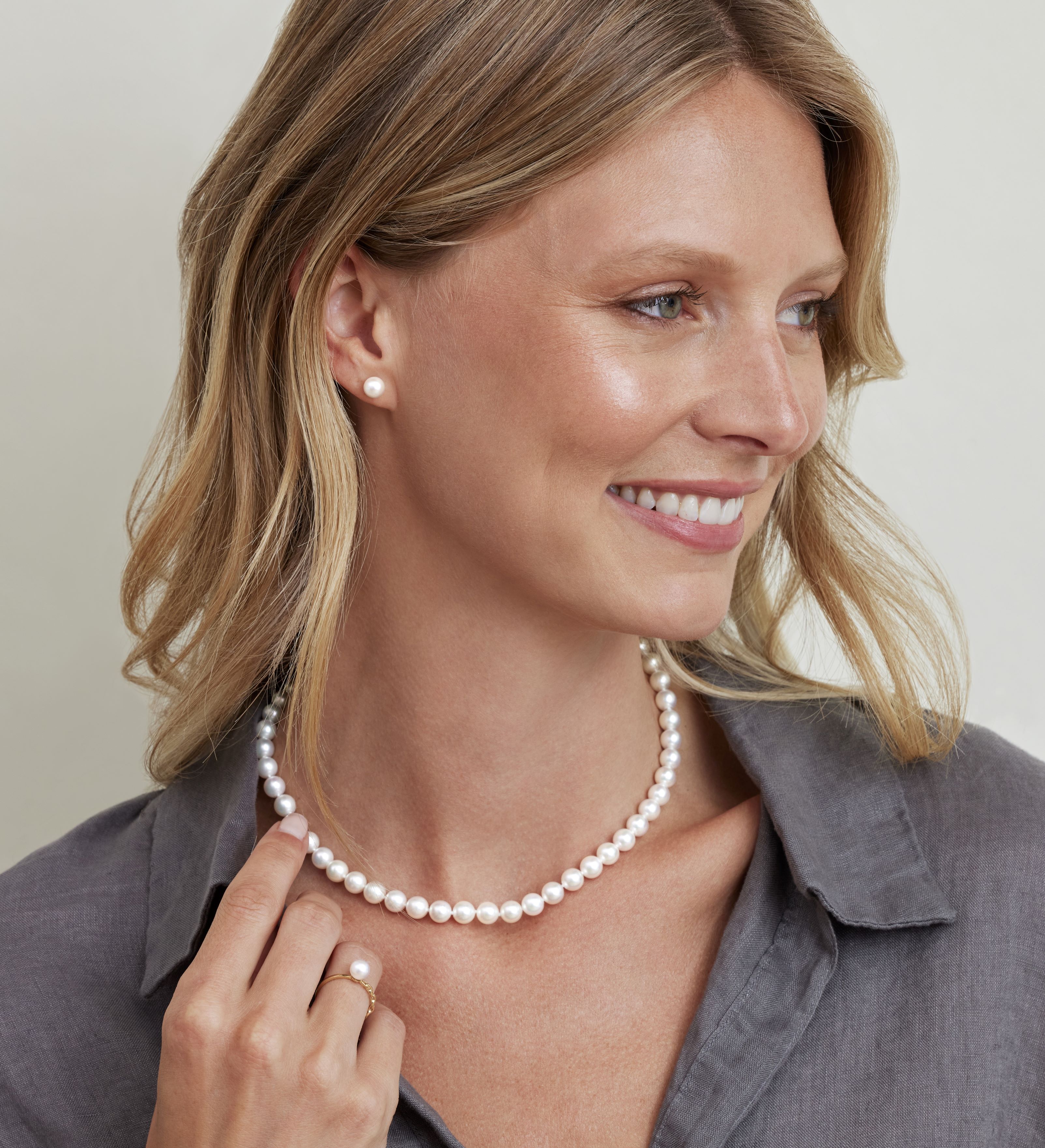
White Akoya pearls are one of the major cultured-pearl types used in jewelry.
11. There are Four Major Types of Cultured Pearls
The four major cultured-pearl groups commonly found in jewelry are freshwater, Akoya, Tahitian and South Sea. Freshwater pearls are produced mainly in China. Akoya pearls are saltwater cultured pearls associated especially with Japan, and are also produced in China. Tahitian pearls are cultivated mainly in French Polynesia and can show gray, green, blue and aubergine tones. White and golden South Sea pearls are known for their typically larger sizes and are produced in regions including Australia, Indonesia and the Philippines. Explore our pearl types guide for a comparison.
12. There is a Pearl Necklace Lexicon
As the popularity of pearls has continued to grow, many different styles of pearl necklaces have emerged. As a result, people have developed a unique set of vocabulary specifically for the size of pearl necklaces. There are a variety of different terms for necklace lengths (from shortest to longest): Choker, Princess, Matinee, Opera, and Rope.
"The pearl is the queen of gems and the gem of queens." Anonymous.
13. Some of the World's Most Influential Women were Huge Fans of Pearls
Pearls have also been worn by some of the most influential women in more recent history. First Ladies including Michelle Obama and Jackie Kennedy both regularly adorned themselves with lavish pearl jewelry while their husbands were in office. In England, Princess Diana was known to have been a huge fan of pearls. Finally, Coco Chanel was a pioneer of fashion and contributed towards making pearls popular as everyday jewelry.
14. Pearls Can Come in Many Different Shapes
While people believe that all pearls are perfectly round and symmetrical, this is simply not true. They actually come in an array of different shapes. The most common include round, off-round, drop, and baroque. Round pearls are a classic choice, while irregular shapes offer a different look. Our Baroque Pearls guide explains how to compare and wear them.
15. Pearl Growth Takes Months or Years
There is no single growth timetable that applies to every pearl. Cultivation time varies with the mollusk, pearl type, growing conditions and desired result. Technicians introduce mantle tissue, sometimes with a bead nucleus, and the mollusk then deposits pearl material over time. Our guide to how pearls are made explains the process.
16. Pearls are one of the Official Birthstones for the Month of June
Those born in June aren't just lucky because the month has three official birthstones, but more so because one of these gemstones is the pearl. According to the legend, the June birthstone is believed to symbolize purity, clarity, and loyalty. Given its symbolic meaning and captivating beauty, the pearls are an especially great gift for anyone born in this month.
As you begin to dive deeper into the history of pearls, it becomes easier to realize exactly why they are one-of-a-kind. These gemstones are not only rich in history that has been closely tied to many ancient cultures, but they also continue to be one of the most popular jewels today.