
Baroque Pearls Guide: Everything You Need to Know

Baroque pearls have irregular shapes that give every piece of jewelry its own character. A curved Tahitian pearl, a softly uneven freshwater strand and a sculptural South Sea pendant can all be baroque, yet each suits a different style and budget. This guide explains what the term means, how to compare the pearls themselves, and which jewelry designs show off their shapes best.
“Baroque” describes a pearl’s shape. It does not mean fake, damaged or low quality. A baroque pearl may be natural or cultured, freshwater or saltwater. Most pearl jewelry sold today uses cultured pearls, which are genuine pearls grown in living mollusks with human assistance.
Some baroque pearls are only slightly uneven, while others have pronounced curves, ridges or free-form silhouettes. A symmetrical drop or oval is a separate shape category, even though it isn’t round. When shopping, what matters most is whether you love the individual pearl’s shape and how the design shows it off.
Freshwater cultured pearls offer a broad choice of shapes, sizes and soft colors, often at accessible prices. Many are tissue-nucleated, though bead-nucleated freshwater pearls also exist. If you’d like to try a distinctive shape without committing to a full strand, a single freshwater baroque pendant is an easy place to start.
Tahitian cultured pearls are known for naturally dark body colors, with overtones that can appear green, blue or aubergine. Curves and circles can make the color seem to shift as the piece moves, which is part of their appeal. When comparing Tahitian pearls, look at luster and surface as well as color, since the darkest pearl isn’t automatically the best.
South Sea cultured pearls bring a larger, more substantial presence to a baroque necklace or pendant. White and golden examples differ in color, and an attractive irregular shape can be the focus of the design rather than something to hide. Check the visible surface of each pearl and how the pearls in a necklace work together. Some of our product titles use “Tahitian South Sea.” In this guide, Tahitian pearls and white or golden South Sea pearls are discussed separately for clarity.
Akoya cultured pearls are closely associated with round strands and crisp reflections, but baroque examples do exist. The choice of baroque Akoya designs is usually narrower than for freshwater pearls. Judge the individual piece rather than assuming a pearl type guarantees a particular shape or level of luster.
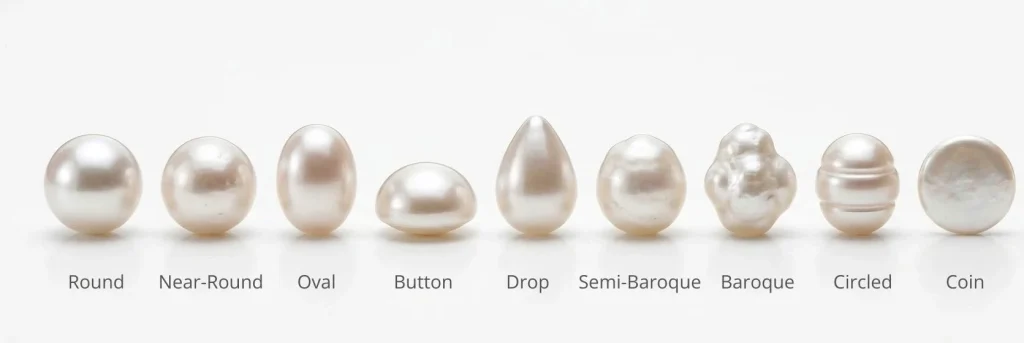
Sellers use several terms for irregular pearls, and labels can vary from one store to another:
Two other terms often appear alongside baroque pearls but mean something different:
Because labels vary, clear photos and the product description are your best guide to what you’ll actually receive.
Start with luster. Look for bright, reasonably sharp reflections rather than a flat or chalky look. Ridges can make reflections and overtones shift with the viewing angle, but they don’t improve luster on their own.
Look at the visible surface. Some texture is part of a baroque pearl’s charm. Consider whether spots, pits or marks are distracting on the side that will show when worn. For higher-priced pieces, ask about nacre quality as well, since shape is only one of several pearl quality factors.
Judge the shape in its setting. A pendant can show off one dramatic side. Earrings need a pair that feels harmonious, even when the shapes differ. A strand needs a pleasing rhythm of size, color, luster and form rather than identical pearls. There’s no fixed “best” shape, only the one that suits the design and you.
Compare like with like on value. Pearl type, size, luster, surface, nacre, color and matching all matter. Round pearls often carry a premium when the other factors are comparable, but there’s no reliable rule that a baroque pearl costs a set percentage of a round one.
Baroque drop earrings show off the pearl’s outline as it moves. Look at both earrings together: the shapes don’t need to match perfectly, but their size, color and luster should feel intentional. For example, our Tahitian Dangling Tincup Earrings pair two dark, irregular pearls in sterling silver or gold-filled.


An irregular strand can be understated or dramatic, depending on pearl size and how much the shapes vary. Notice how the center pearls sit and whether the colors and reflections stay cohesive across the necklace. Our White South Sea Baroque Pearl Necklace shows the larger-scale end of this choice.
A single pearl on leather or cord puts the focus on one organic shape and looks more relaxed than a full strand. Check the cord length, clasp and how the pearl will hang. These designs, like our Golden Baroque Leather Necklace, are easy to wear with everyday outfits, but remove pearl jewelry before swimming, bathing or rough activity.


A pendant is a practical way to choose a shape you personally love. View the front and side if you can, and check that the setting presents the pearl’s best face when worn. Our White Freshwater Baroque Pearl Arlet Pendant is a simple single-pearl design on a sterling silver chain.
On a bracelet, consider how the pearls and setting move against the wrist. A strand shows off a coordinated sequence of shapes, while a single baroque pearl on leather makes a quieter statement. Our Tahitian Baroque Pearl Leather Bracelet takes the second approach.

Confirm the pearl type, color description and any disclosed treatment. Compare close-up images, dimensions and photos of the piece as worn, since an unusually shaped pearl can look quite different from the side. Check the setting, clasp or stringing, and the return terms.
For a high-value claim about natural origin or treatment, ask what independent documentation supports it. Once you’ve settled on a style, you can browse current designs in our Baroque Pearls collection.
Baroque pearls need the same care as round ones. Put them on after perfume, hair products and cosmetics, wipe them gently after wear, and store them separately from harder jewelry. Avoid ultrasonic and steam cleaners, and let a damp strand dry fully before storing it. Our Pearl Care and Maintenance Guide covers the full routine.
Yes. Natural and cultured pearls can both be baroque, but shape alone can’t establish authenticity. Check the seller’s disclosures, and get a qualified laboratory report when a pearl’s claimed origin or treatment significantly affects its price. The tooth test isn’t a reliable substitute.
Often, when otherwise comparable pearls are judged in a market that prizes roundness. But a baroque pearl can still be valuable, or simply more appealing to you, because of its luster, size, color, surface and distinctive form. There’s no universal price ratio.
Not automatically. “Coin” describes a flat, disc-like shape, and “keshi” describes a non-bead cultured pearl. Either may be irregular, but neither term means the same thing as baroque.
Choose a baroque piece by looking at the whole design: the pearl’s luster and surface, the shape you love, how multiple pearls work together, and how the jewelry sits when worn. Then compare products within the same pearl type and price range. An irregular outline is the beginning of the choice, not the final measure of quality.
Signup now and receive an email once I publish new content.

Content Writer and Editor at The Pearl Source
Kate Muirhead is the editor and content writer for leading pearl retailer The Pearl Source. She believes in the power of signature jewelry, and that collecting it is half the fun.
 Best Online Jewelry Stores for Different Types of Jewelry